Wednesday, May 26, 2021

A Working Family Heirloom - The Kodak Brownie 2A


The Kodak Brownie Model 2A

Several years ago my dad gave me an old Kodak Brownie camera that was found in the personal effects of his uncle, Crilly Marshall Lunsford shortly after his death. Until recently this antique curiosity sat on my bookshelf collecting dust. 

From the Brownie Camera Page, we find the following specifications:

Introduced: April 1907

Discontinued: 1936

Film size: 116

Negative size: 2 1/2 X 4 1/4"

Lens type: meniscus

Shutter type: rotary

Units made: over 2,100,000 before 1921

Original price: $3.00

After doing a bit of research, I soon found that these old gems may still work. While the original #116 film no longer is available, I found a source for adaptors that allow the use of modern #120 roll film. So after a bit of cleaning, I decided to give it a try. 

Each roll allows for six pictures. And unlike a few decades ago where every drug store offered film processing, this film can only be handled by a few specialty labs across the country and its a bit pricy (around $20 per roll). So far I've had good success with this lab although it can take several weeks to get digital scans back.

Here's an outdoor shot on a snowy overcast day using Kodak B&W T-Max 400 film. This used the middle stop opening and the internal shutter speed.


 Whereas this is a two second exposure of an indoor scene. It was taken by placing the camera on a table in a room with a western exposure on a sunny day. There is a small tab that can be pulled out on the camera to allow for manual shutter speed control.

Overall, this is a fine little box camera that produces a respectable picture. And the picture clarity is not bad for what is essentially a card board box with a single lens and very basic shutter mechanism. And after years of digital photography, it was nice to once again experiment with film.

Monday, May 3, 2021

Guest post: Lunceford/Lunsford Ancestors in the American Civil War


Benjamin Richard Lunceford
Company C, 8th Virginia Infantry


When my aunt, Dorothy Lunceford Ayres passed at 99 in 2014, we discovered among her things the entire muster records of her grandfather (my great-grandfather) Benjamin Richard Lunceford (1837-1900). Benjamin Richard was married to Amanda Creel and they had 8 children, my grandfather, Benjamin Harrison (1881-1931) was one of them.  Sparked by this find, I started to investigate Benjamin Richard and have come to discover quite a bit about him, his brothers and cousins and their service in the American Civil War.

 As a child we visited the Warrenton Cemetery at holidays and saw the cast Confederate Veteran iron cross at the base of Benjamin Richard’s headstone (located directly behind my grandparents) but was unaware of his Civil War service. Growing up I never really heard many ancestral service stories other than my uncle Carlton Lunceford (KIA Anzio WWII). I think it was because my grandfather died in 1931 in a farm accident and my grandmother Addie Pearl Griffith Lunceford died in 1960 when I was 4. So the stories had faded.

On another note, my father John Turner was from Newport, Kentucky (across from Cincinnati). His grandfather, Thomas Z. Turner, was in the Union Army with the 155th Pennsylvania Volunteer Infantry. He appeared to have enlisted in 1862 and served until June of 1863 just prior to the Gettysburg campaign.

When reviewing old historical documents, I need to qualify some of my findings. Getting fully sourced information is difficult and sometimes you must read between the lines or make assumptions based on deduction. There are also some contradictions and assertions in conflict from one account to another.  If you are reading this, you may have family lore that I am not aware of and could add to the discovery. Any information you would like to share can be added to the comments at the end of this post.

 Ancestor Lineage and Civil War Muster Records

I have tried to include all Lunceford/Lunsford brothers and cousins as I could confirm. But there are cousins that I have yet to investigate. They would be Creels and Balls, etc., and they are offspring of the daughters of Baldwin and or Benjamin. Number to the right of birth/death in [..] is age in 1861. Click on the name to go to their family sheets in the database.

Baldwin Lunceford/Anna Ball > Benjamin >

    1)    Benjamin Richard - (1837-1900 [24]) - 8th VA INF

    2)    Evan Owen - (1833-1901 [28]) - 8th VA INF 

    3)    Elijah Chilton - (1829-1921 [32]) – 43rd VA CAV (Mosby’s Men)

Baldwin Lunceford/Anna Ball > Benjamin > James W. >

    4)    John Henry - (1846-1934 [15]) – 43rd VA CAV (Mosby’s Men) 

    5)    James William Jr. - (1848-1935 [13]) – 43rd VA CAV (Mosby’s Men)

Baldwin Lunceford/Judith Creel > Wormley >

    6)    Joseph Blackwell - (1841-1861 [20]) - 8th VA INF

    7)    William A. - (1843-1864 [18]) - 6th VA CAV

Baldwin Lunceford/Judith Creel > Harrison >

    8)    James D. - (1834-1864 [27]) - 8th VA INF

    9)    Samuel - (1844-???? [17]) - 16th VA INF

1) Benjamin Richard Lunceford (my great grandfather, sometimes called “Benedict” Lunsford and “Lansford”), Company C, 8th Virginia Infantry. He mustered into service on July 13th, 1861 in Leesburg by Capt. Edmund Berkeley. He seemed to be somewhat of a rascal as I have found references to him as being a sharpshooter and possibly credited with shooting Col. Edward Baker (a sitting United States Senator from Oregon) at The Battle of Ball’s Bluff in October 1861 (Note 1). He also is known for his shooting skills at The Angle during the battle of Gettysburg, July 1863 where he and two other Luncefords (his brother Evan and cousin James) fought. He and his cousin James were captured, as reflected in their muster records. He is listed as a private, corporal, sergeant and even a Colonel in different excerpts and as having been admitted to the famous Chimborazo Hospital in Richmond for something called ‘Catarrh Fever’ from June 12 - 23 1862. He was imprisoned at Ft. Delaware Prison and later paroled at Point Lookout, MD February 18th, 1865. Buried in the Warrenton cemetery.

2) Evan Owen Lunceford (my great grandfather’s brother) Company C, 8th Virginia Infantry, listed as wounded at Gaines Mill (also Chickahominy) June 27, 1862. Listed as captured July 3rd, 1863 (in some excerpts) at the Angle, Gettysburg along with Benjamin and their cousin James D. However, his muster records are contradictory as to capture where Benjamin's and James D.  records clearly state that they were captured July 3, whereas Evan’s record does not. Buried in the Oak Grove Baptist cemetery, Greenwich, VA.

3) Elijah Chilton Lunceford (my great grandfather’s brother). He rode with Mosby’s Raiders, Company E. His service is described in a previous post (Note 2). Buried at the Marshall Cemetery.

4) John Henry Lunceford (my great grandfather’s nephew) - Signed on with Mosby at the very young age of 16 or 17 as a scout(?). Listed as captured by the Federals with some controversy that can be researched elsewhere. Buried in the Westminster cemetery, Delaplane, VA (Note 3).

5) James William Lunsford (my great grandfather’s nephew) - Also rode with Mosby (Company E) as a scout(?) albeit briefly in 1864-5 as he too was barely 15 or 16 years old.

6) Joseph Blackwell Lunceford (my great grandfather's 1st cousin) 8th Virginia Infantry. Killed approaching the old Stone House at First Manassas, July 21, 1861. Wound listed as through the heart. Believed buried in a mass grave at the Groveton Cemetery on the battlefield (Note 4).

7) William A. Lunceford (my great grandfather's 1st cousin) 6th Virginia Cavalry. Died in hospital, Winchester, VA, 12 Nov 1864 from wounds sustained two months earlier at Newtown (Stevens City). His burial is at the Stonewall Confederate cemetery in Winchester, VA (section VA-95) (Note 4).

8) James D. Lunceford (1st cousin to Benjamin and Evan). Company F, 8th Virginia Infantry. Reported as wounded at Gettysburg and listed as “having killed more Federals than any in other” that day. His muster records are interesting and contain some controversial statements. For instance, he is listed as present March & April 1863, absent September & October 1863 and November & December 1863 - “Taken prisoner at Gettysburg July 3, confined in Ft Delaware”.  For the period January & February 1864, the remarks say “Made prisoner at Gettysburg July 3, 1863. Afterwards joined the enemy. Deserter”. Reported as died in captivity at the notorious Ft. Delaware Federal Prison, March 12, 1864 due to inflamed lungs. He was also wounded at Darbytown June 30, 1862 and sick in 1861 (Note 5).

9) Samuel Lunceford, 16th Virginia infantry. Many listings for being sick (Impetigo, lower left thigh infection, scurvy or wounded) also at Chimbarzo and the Episcopal Church Hospital, Williamsburg.

Notes:

1)  Regarding the battle of Ball's Bluff, from: “The 8th Virginia Infantry Regiment, "The Bloody Eighth" by JDWoody

“Hunton ordered his skirmishers out into the adjacent tree line to open fire on the commander and his men. Sergeant Benedict R. Lunceford led his squad into the trees to open fire on the Yankees. Loading his Model 1861 musket, Sergeant Lunceford took aim at Colonel Baker. Readying his shot, he squeezed the trigger and fired, sending a roundball through the neck of Colonel Baker. The Union colonel fell to the ground grasping his bloodied neck, choking to death on his blood. Sergeant Lunceford had just killed the first and only U.S. Senator to die in combat.”

In Benjamin Richard’s service record, there is no listing as being a sergeant, nor is there any other evidence for his role in the Baker shooting. This point requires more research.

From: “Pickett’s Charge: A New Look at Gettysburg’s Final Attack”. By Phillip Thomas Tucker, PhD. Skyhorse Publishing, NY 2016.

Tragedies among Brothers…..Meanwhile, two sets of 8th Virginia brothers, advanced side by side: Privates John L. Bailey and Edwin S. Bailey of Company D (Champe Rifles),………and Corporal Benjamin R. Lunceford and Private Evan[s] O. Lunceford, both of whom enlisted in the summer of 1861 at Leesburg, Virginia of Company C (Evergreen Guards)………”

Savage Hand-to-Hand Combat at the Copse of Trees…… The men who had gained the stone wall and the clump of trees continued to inflict damage on the resurgent Yankees, especially the 69th Pennsylvania. One Rebel excelled in the grisly art of killing his fellow man. He was an expert marksman who never missed a shot. Firing through a narrow gap in the stone wall where piled-up stones had either knocked down or deliberately removed, Private James D. Lunceford, of Company F (Blue Mountain Boys), 8th Virginia, on the far right of Garnett’s brigade, blasted away through this ideal firing position that provided protection. Meanwhile, comrades, including a brother, hurriedly hand-loaded and passed muskets to Lunceford in an assembly line of death. Because of the density of the encroaching blue ranks, some of Lunceford’s well-aimed bullets dropped two men with a single shot, with the bullet whizzing completely through the foremost Federal to find another victim immediately behind him. From this vantage point, this especially young Blue Mountain Boy “killed more men than any other during the assault.” However, Lunceford fell wounded and was captured. He was fated to die a captivity prisoner in a filthy northern prison, earning a shallow grave in New Jersey soil in 1864. James paid the ultimate price for “getting two [Yankees] at a crack”.”

From: “Pickett’s Charge – The Last Attack at Gettysburg” by Earl J. Hess. The University of North Carolina Press, 2001.

 “The same process took place among many other groups along the outside of the stone fence. First there was fierce defiance, then there was doubt about the prospects of help arriving, then there was the grim realization that a decision between flight and capture had to be made. Lt. Charles Berkeley of the 8th Virginia gave his handkerchief to Cpl. Benjamin R. Lunceford and told him to put it on a ramrod and wave it as a token of surrender. But Lunceford was so intent on firing, having been supplied with a steady source of off-loaded and capped muskets by his brother, that he exclaimed, "Hold on awhile Lieut. I am getting two at a crack." His comrades later argued that no one in the division killed more Yankees during these few minutes than Lunceford.”

2) See previous post, “Family Mementoes and Warrior Ancestors”.

3) See previous post, “A Close Encounter with COL Mosby's Pistol”.

4) See previous post, “A Priceless Family Heirloom; Wormley and Mahala's Bible”

5) See previous post, “Guest Post: Which John?”


Carl Turner

Wednesday, March 31, 2021

Recent Adventures with Autosomal DNA

Plot of an autosomal cluster analysis

 So far the DNA analysis of Baldwin's line has concentrated primarily on the Y-chromosome of male descendants in order to confirm both paternal genetic descent and the public paper record. That's because the Y-chromosome is passed down from father-to-son along with the surname, and it is a powerful tool for following the paternal line back to a common, distant male ancestor. These studies also can be used to connect male lines back to ancient times; well before the advent of surnames.

But we have other chromosomes in our cells besides Y; a second sex chromosome (X to go with the Y for males and two X [XX] for females), and 22 chromosomes that are known as the "autosomes". Autosomal DNA is inherited equally from both parents, and for any one person it is a random mix coming from four different directions (from both sets of grandparents). Autosomal DNA analysis lets you examine both your maternal and paternal lines at the same time. But because the DNA is diluted at each generation by the addition of a new parental line, the results are only really accurate back to the fourth or fifth cousin level.

Back when I began my Y-chromosome analysis I also submitted an autosomal test. The price was right and I figured it might be useful for finding additional male cousins for Y-chromosome testing. While the Family Tree DNA database only allowed me to confirm some of my side lineages through autosomal DNA (for example my biological connection to the Wine, Griffith and Hager families on my paternal side and Johnson, Allen and Ridgley families on my maternal side), I had very limited luck matching to any Lunceford/Lunsford families. At least any that posted a family tree or responded to my email inquiries. That was until I transferred my results to MyHeritage.com. Almost immediately I was able to find several interesting Lunceford/Lunsford connections. For privacy reasons I will not disclose their actual match names here, but I will discuss their ancestral lines. 

The first significant match was to a Carter family who descends from Samuel Shelton Lunceford. He was the brother of my great-great grandfather and was one of three sibling brothers who left Fauquier County Virginia in the mid to late 1800s to settle in Missouri. We already had a very strong paper record genealogy for these folks, but biological (genetic) confirmation always is a welcome addition to any family project. 

But a genetic breakthrough was in store..............

Going back to our Y-chromosome analysis, we previously were able to confirm paternal genetic descent from Baldwin's first son, Benjamin Lunsford (abt 1793-1869) through his Anna Ball line. Absolute confirmation of Baldwin's Y-chromosome haplotype requires the testing of a living male who descends from his second wife's line (Judith Creel). Finding a willing test subject for this analysis so far has not been successful. But there is a glimmer of hope using autosomal DNA. Two significant matches were found in the MyHeritage database to Baldwin's Judith Creel line. One was to a Lunsford male who descends from Maphis Franklin Lunsford (1910-1992). Maphis descends from Wormley Lunceford (1814-1893). Until this match, I had no idea Maphis had any sons. The second connection to the Creel line is through Baldwin's daughter Judith Lunceford (abt 1817-1890). This connection comes to us through the McCausland family. 

It was exciting to have discovered two seperate connections to Baldwin's Judith Creel family. But for final confirmation I still need to find a living Lunceford/Lunsford male from that line to agree to do a Y-chromosome test. So far my emails and Facebook Messenger requests to potential descendants have been ignored. But the search continues.

One final match is worth noting. It is a very distant cousin match where the DNA confidence is low. But in this family there is a Lunsford clan from Arkansas and Tennessee. While there always is the possibility that having Lunsfords in their tree is coincidence and my DNA match is actually coming from another lineage, this would be the first time I've seen anything matching us to a Lunsford clan in the deep south. Could this somehow be related to Rodham, Baldwin's suspected brother who left Fauquier County after the Revolution to live in Kentucky? Or are they descended from Northern Neck Lunsfords who went south instead of migrating to what was to become Fauquier County? Only time will tell.

While Family Tree DNA is more Y-chromosome centric, I have to admit I prefer the dashboard and analytical tools at MyHeritage for examining autosomal matches. The figure at the top is an example of a cluster analysis. For privacy reasons I've removed the match names. This is a readout of my matches arranged in clusters (each match is a square) where they match to me but also to each other. Colored squares are matches and greys are non-matches. This process helps group related matches to individual family lines. The red cluster in the upper left corner are the Lunceford/Lunsford matches. While the tan and yellow clusters are for lines from my maternal side. I'm still analyzing the smaller clusters trailing off to the lower right corner. Aside from the DNA itself, each match requires looking at their submitted family trees. Some are extensive and it is easy to find a familiar surname connection. While many either don't have a tree or they just don't bother to respond to emails.

These new autosomal matches prove that even though it is easy to become single minded when pursuing Y-chromosome studies for the paternal line, it is important not to discount the autosomal data as well. One never knows what interesting connections might arise.


Monday, March 1, 2021

Re-animate Your Ancestors


The face animation tool on MyHeritage.com has been getting a lot of attention on the genealogy blogs today. To use it you need to sign up for a free trial and then pay a subscription to continue. I managed to run through a couple of my best ancestor photos before it locked me out.

Here is a short clip of my great grandfather, Edgar Marshall Lunsford (1870-1953) taken around 1928-1930. It's a bit freaky to be able to re-animate someone from an old photo like this.

Thursday, February 4, 2021

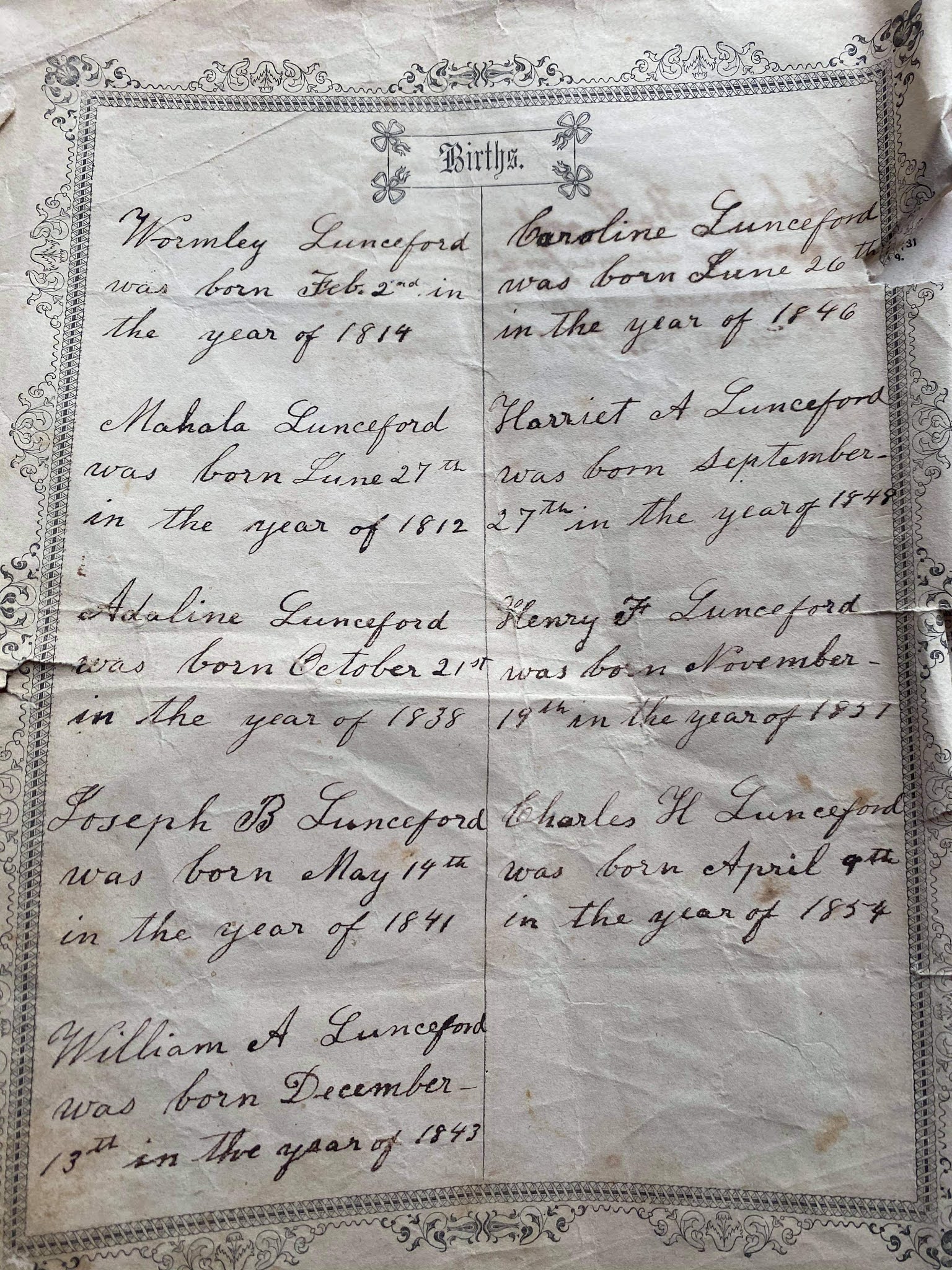
A Priceless Family Heirloom; Wormley and Mahala's Bible


When conducting genealogical research, one can never tell when the next priceless gem will come along; maybe a long-lost cousin connection, an unexpected DNA match, a critical court house document or a family heirloom. 

To run down new leads on Baldwin's origins, I recently joined several Facebook groups specifically dealing with genealogy and the history of areas where our ancestors lived out their lives. Through one of these groups, it only took about a week before I had the pleasure of connecting with Lee Pearson of Manassas, VA. Lee descends from Baldwin's second family (Judith Creel line). The sequence is Baldwin > Wormley > Henry Franklin through his mother, Ella Catherine Lunceford. He recently contributed a guest post on his boyhood home in Haymarket, VA. 

Although I am not connected directly to Wormley's line, I've always been fascinated by that given name. In my experience, Wormley was not used elsewhere in Baldwin's lines. But I have come across this name in other Northern Neck families with the spelling "Wormeley". Not to mention that it also was a surname (see Elizabeth Wormeley). Multiple connections of the Ball family with our early Virginia lines continues to keep up my hopes of one day connecting Baldwin's origins to the Northern Neck counties.

Here we have scans of the front pages of Wormley and Mahala's family bible that Lee was able to recover from the household of his grandmother, Mary Margaret (Ball) Lunceford (click for larger views):

Marriages

Births

Births (cont.)

Deaths

As a kid growing up just south of Manassas, we were taught early and often of the significance to the Civil War of the Battle of First Manassas. Field trips to that park were a common childhood treat. So when I read the death entry for Joseph Blackwell Lunceford (aged 20), passing that day in July of 1861, it became very real indeed. I didn't know of any of our clan being killed at that first decisive battle of the war (also known as The Great Skedaddle). Joseph was a private in Company-C, 8th VA Infantry, and before the conflict worked for the Berkeley brothers in Haymarket who later became company commanders in the 8th under Colonel Eppa Hunton.

We already know of my Great-great grandfather Elijah Chilton's time with the 43rd Virginia Cavalry (Mosby's Men), and of his cousins service in the 8th (topic of a future post). But this was the first time I had heard of Joseph Blackwell. Lee tells me that he was shot through the heart while approaching the Henry House. He is believed buried in a mass grave at Groveton about a mile from the old Stone House.

Also listed is the death of Joseph's brother William A. Lunceford (aged 21). He died later in the war fighting in the Valley Campaign with the 6th VA Cavalry at Newtown (today's Stevens City). Although the exact day cannot be determined from the bible entry due to page damage, he passed some weeks later in a Winchester hospital either in October or November of 1864. An entry on Find-a-Grave cites 12 Oct 1864 but the US Death Index gives his death as 12 Nov 1864. His burial is at the Stonewall Confederate cemetery in Winchester, VA (section VA-95).

This discovery of a priceless family heirloom so close to Baldwin's time makes me wonder how many other important items may be out there in private hands just waiting to be found or worse yet, lost to time. If you have any documents, photos or artifacts relating to our family that may be unknown to others, please scan/photograph them and make arrangements to pass them down to your descendants. And if that information can further our family's genealogical story, please send me a copy for the archives and perhaps consider writing a post about them on Bull Run Mountain Memories.


Wednesday, January 20, 2021

Privacy, Web Servers and a Database Update


 If you mouse over to the right-hand side of this page you will see a link to the latest update to our master family tree. This update was several months in the making, and since earlier versions required a lot of manual hand coding in HTML, I was not in a big hurry to open that can of worms. Best to wait for the next big snow day. To make matters worse, my local ISP retired its free server space. So once the source files were deleted there was to be no turning back.

What finally greased my gears into action was an unexpected email I received from a distant relative. It seemed he was concerned that his family sheet could be used for targeted phishing attacks. If this were 1990 I would say that holds water, but this is 2021 and the amount of personal identifiers available on just the open source web is astounding and way above anything that could be harvested from a family tree. I'm afraid the cows left that barn many years ago.

In earlier versions of our on line tree I was careful to exclude the birth dates of living individuals. Now-a-days those are easily harvested from your local PTA or HOA directory. And if you want just one example of a very powerful association aggregator, check out Family Tree Now. It's amazing what you can find here on living individuals with just a little digging (although some associations, addresses and phone numbers are bogus or out of date). I even used this site to confirm some of my past addresses the last time I had to put in my paperwork for a security clearance.

Our current tree was published with the web page functionality built into the Roots Magic genealogy software I use for my day-to-day research. In early trials it seems to do the job and it looks like future updates will be much easier. But it will take me time to go back and fix broken family page links in prior posts. So please be patient.

You also will notice that this newer version no longer has entries for living individuals. The Roots Magic software does not allow for birth date exclusion, only living person exclusion. Hopefully this will allay future security fears you might have.

I rarely use open source trees posted on such sites as Ancestry.com. These are riddled with errors and wishful thinking. Most all of my entries come from trusted fellow researchers or census, birth/death certificates, deeds, family bibles and grave markers. But even those sources are never perfectly accurate. So if you come across an incorrect spelling, date or family association, please let me know. But also include your source for the correction. When conflicting dates or spellings are encountered I always opt for the public record first.

Sunday, January 10, 2021

Guest Post: The Pearson House in Haymarket Virginia

The Pearson House depicted in the 1940s

Editor's note: This post comes to us courtesy of Lee Pearson of Manassas, VA. It is a vignette about his childhood home and a painting he did from memories of living there in the 1940s. Lee descends from Baldwin through his son Wormerly (Judith Creel line). In a future post we will examine his line in greater detail when we feature a significant heirloom in his possession..

Nestled among the honeysuckle lies the Pearson House, one of four structures that escaped the rapture of the Northern armies during the Civil War.

Passing is a steam locomotive the likes of which would have carried Southern soldiers and horses rushing from the Shenandoah Valley to be in the Great Battle of Bull Run/Manassas on July 21, 1861. The first time in history of the world soldiers and horses were delivered to battle by train/railroad.

Behind this house is St. Paul’s Church on Fayette Street. With the doors wide open on that very hot day. Church services were in progress during which time cannon were heard by the congregation, echoing from battle in Manassas, but would not have been heard by the troops on their mission due to the iron clatter and steam from the locomotive.

Undoubtedly, many would have glanced at this house on passing that day, but with little thought of it at this time, as their concerns were of their fate minutes away in battle.

Lee Pearson
Manassas, VA


Thursday, December 24, 2020

Searching for Lord Fairfax (Updated, 2X)

Thomas, 6th Lord Fairfax of Cameron

As an amateur historian growing up in northern Virginia I was fascinated by Lord Fairfax and the family's claim to the huge Northern Neck Proprietary. This was a land grant of five million acres containing all of the counties of the Northern Neck lying between the Potomac and Rappahannock Rivers as well as all of what was to become the northern Virginia counties out to the source spring of the Potomac. Its southern boundary was a straight line cutting across the Blue Ridge range and Shenandoah Valley connecting the Potomac headspring to that of the Conway (origin of the Rappahannock River system) river. Originally, this vast area, much of it unmapped, was given to seven Englishmen by Charles II for their loyalty in helping him regain the throne after the execution of his father, Charles I, during the English Civil War. Just how all of that land ended up with the Culpepper family and eventually finding its way to Lord Fairfax is lengthy and will not be described here. But to get the full story, check out this post in Virginia Places.org. It is a fascinating read. There are several maps of that time showing the boundaries of the grant. My favorite is the Jefferson-Fry map of 1753. Peter Jefferson was the father of Thomas Jefferson.

Fairfax (1693-1789) was unique in that he was the only English noble to have lived in the American colonies. His seat of power was at Greenway Court near the village of White Post in Clarke Co. It's on private property and the only remaining structure is a small stone hut that served as his land office

He also died here and is buried in Winchester. But where? Back in 2014 I had some time to kill while in town so I decided to find out. As always, Find-a-Grave is the go to source for these things and directed me to the Christ Episcopal Church. But when I got there I was shocked to see only his above ground tomb sandwiched in between the city side walk and the church building. There was no churchyard cemetery and not all that much room for such an important burial. Almost like it was placed as an afterthought. 


After a little more research it became clear that he spent most of his worship time at the Old Chapel near Millwood just down the road from Greenway Court. 

View from the cemetery


Road marker

This is a neat little stone church with a large graveyard. But as the local population grew, need arose for a new larger church in Millwood, and parish boundary changes led to building the other church in  Winchester. It's unclear why Fairfax wound up in Winchester and not at the Old Chapel cemetery. There are some really old graves there and a big surprise for me was finding Edmund Randolph.. Randolph is a true patriot. He was one of the original Virginia delegates to the Constitutional Convention. He not only served as aide-de-camp to Washington during the Revolution, but also as governor of Virginia, US secretary of state and the first US attorney general. But how did a Tidewater boy living in Richmond most of his life wind up buried in a small churchyard in the Shenandoah Valley? It seems that in late life as a widower he spent time visiting Nathaniel Burwell at Carter Hall plantation in Millwood. The mansion is practically across the road from the new church in Millwood, and I had the chance to tour both the new church and Carter Hall as part of a Mosby Heritage Association lecture a few years back. An added bonus was a chance for getting inside the Old Chapel. The vicar at the new church opened it up for folks willing to venture down after the lecture. It's normally only open by special appointment and for their Easter service.

Pulpit

 
Pulpit view to entrance

So now we know a bit more about Fairfax and the land grant that contained our ancestral lands in northern Virginia.

UPDATE (March 2021):
Since publishing this post, I came across a copy of Fauquier During the Proprietorship: A Chronical of the Colonization and Organization of a Northern Neck County by H. C. Groome (Reginal Publishing Company, Baltimore, MD 1969), originally published in 1927. This book is a treasure trove of information on the formation of Fauquier County with fascinating details about the Northern Neck Proprietorship. It is an essential library item for anyone interested in the early history of Fauquier County in particular and the colonization of Virginia in general.

 Although Fairfax originally surveyed several sections of his vast claim for his own use, with the 119,927 acre "Leeds Manor" being planned for his eventual estate, he never built there. Preferring to open his land office at Greenway Court on the western side of the Blue Ridge in the Shenandoah Valley.

On page-71, Groome cites Burnaby's 1798 description of Fairfax's "way of living" at Greenway Court:

"He kept many servants , white and black; several hunters; a plentiful but plain table, entirely in English fashion; and his mansion was the mansion of hospitality. His dress corresponded with his mode of life, and, notwithstanding he had every year new suits of clothes, of the most fashionable and expensive kind, sent out to him from England, which he never put on, was plain in the extreme. His manners were humble, modest and unaffected; not tinctured in the smallest degree with arrogance, pride or self-conceit. He was free from selfish passions, and liberal almost to  excess. The produce of his farms, after the deduction of what was necessary for the consumption of his own family was distributed and given away to the poor planters and settlers in his neighborhood. To these he frequently advanced money, to enable them to go on with their improvements; to clear away woods, and cultivate the ground; and where the lands proved unfavorable, and not likely to answer the labor and expectation of the planter or husbandman, he usually indemnified him from the expense he had been at in the attempt, and gratuitously granted him fresh lands of a more favorable and promising nature. He was a friend and father to all who held and lived under him; and as the great object of his ambition was the peopling and cultivating of that fine and beautiful country, of which he was the proprietor, he sacrificed every other pursuit, and made every other consideration subordinate, to this great point. He presided at the county courts held in Winchester, where during the sessions he always kept open table; and acted as surveyor and overseer of the highways and public roads. His chief, if not sole amusement was hunting; and in pursuit of this exercise he frequently carried his hounds to distant parts of the country; and entertained every gentleman of good character and decent appearance' who attended him in the field, at the inn or ordinary, where he took up his residence for the hunting season."

In the final chapter Groome gives us clarity on Lord Fairfax's final hours. He died on 9 December 1781 not at Greenway Court but in Winchester after a ride to see his physician. He first was buried at the Frederick parish church in town that he erected in 1762. But later his remains were removed to Christ Church. And in 1925 a new bronze table was placed that we can see today:

"Under the spot repose the remains of Thomas, sixth Lord Fairfax of Cameron, son of Thomas fifth Lord Fairfax and Catherine Culpepper, his wife. Born at Leeds Castle, County Kent, England, October 22, 1693. Died at his proprietary of the Northern Neck in Virginia, December 9, 1781, in the eighty-ninth year of his age. He was buried in the original Frederick Parish Church at the corner of Loudoun (Main) and Boscawen (Water) streets, whence his remains were removed to this church in 1828; where they were reinterred in 1925, when this tablet was erected by the Vestry of Christ Church."

UPDATE (July 2021): 
It seems the historical snowflakes and "perpetually aggrieved" have come for even the good Lord FairfaxThe charge; simply living in his own time and place when men were men and chattel were chattel. The remedy; being judged by present-day standards and CANCELLED. And of course no surprise that the academy was involved. That one institution (and their historians in particular) who really should know better. Clearly the intellectual cesspool from which most current revisionist neo-Marxist doctrine emanates. For the record, Lord Fairfax was one of the most benevolent masters and country gentleman in all of Virginia for his time (note above). The revisionists have no real clue and only see the name.

But never fear; it's all rainbows and unicorns, or in this case; pretty flowers:

"Virginia’s State Board for Community Colleges today approved changing the name of two of the commonwealth’s 23 community colleges, including Lord Fairfax Community College, which will become Laurel Ridge Community College. The new name, selected by a task force of students, faculty, alumni, LFCC retirees, community members and college board members, is drawn from the native laurel flower that is characteristic of the region, and the proximity of the college’s four locations to the Blue Ridge Mountains." 

How nice. But speaking of Lords and Ladies, I'm reminded of a time, many years ago, when Saturday Nigh Live still was worth watching.


Sunday, December 13, 2020

Baldwin Lunsford's Will, Estate Inventory and Sale


A farm lane near The Plains, VA (2014)

As our earliest known paternal ancestor, the search continues for Baldwin Lunsford's origins. Who were his parents? Did he descend from the colonial era Lunsford families of the Virginia Northern Neck? Is there a connection to Stafford and/or Prince William Counties before the formation of Fauquier County in 1759? We may never know as the public records from this period are sketchy at best and no extant family bibles or parish records seem to exist. But the search continues. 

However, we are fortunate to have a very detailed record of his property and affairs at the time of his death in October 1850. This comes to us through his will, estate inventory and sale ledger. Notice that the surname spelling varies between the "ce" and "s" versions; sometimes even within the same document. Baldwin was a farmer and could not write his name (he signed with his mark, X). We have no way of knowing whether he preferred the "ce" or "s" spelling when asked by an attorney, court clerk or census taker.

Baldwin registered his will with Fauquier County on June 2, 1847. What was the United States like at that time?  The Mexican-American War raged, Samuel Colt sold his first revolver, the American Medical Association was founded in Philadelphia PA, and James K. Polk (D-Tennessee) was president. California was only a territory and the US government issued its first postage stamps featuring George Washington and Benjamin Franklin. And according to Wikipedia, the hard candy "Necco Wafers" were invented near Boston MA. Known at the time as "hub wafers", they were said to be a favorite of Union troops in the upcoming Civil War. You can still buy this candy today and the manufacturer claims that it is true to the original version of that time.

In a previous post we described the end of British Primogeniture and how this led to a flurry of chancery causes from family members contesting will provisions or the actions of Executor(s) [person(s) named to settle the estate]. In this regard, we are fortunate that the Library of Virginia has taken the time to digitally scan chancery files from court houses across the Commonwealth as part of their Virginia Memory initiative. While you can visit a court house record room today and find the original copy of a registered will, and while there are genealogy books on the market that index will books or even attempt full transcriptions; chancery files contain not only a copy of the will, but accessory documentation that can help you understand the relationship between the testator [will owner] and his executors and legatees [persons to whom personal property is designated to be given]. If land, property, money or business interests were involved, most likely there will be an estate inventory/appraisal and sale records of how the property was liquidated.

For Baldwin's estate, we have a chancery file from 1854 (Fauquier Co 1854-010). Washington Garrison and Wife vs Executor of Baldwin Lunceford, etc. Washington Garrison married Baldwin's daughter, Margaret Lunceford on 15 February 1850. I don't have any other data on this couple, and this is a very complex file and much of the hand writing by the court clerk is illegible. But a full analysis of this case will be the subject of a future post on BRMM. 

For now, from this file we can extract copies of Baldwin's will, estate inventory and sale ledger. All from the comfort of our home computer without the pain and expense of visiting the court house record room.

Click on each of the following images for a larger view of the document. They are followed by my transcription as best as I could decipher them. Notations and spellings were not corrected to modern day usage as I tried to keep the text as near to the original as possible.

Baldwin's Will:


In the name of God, Amen! I, Baldwin Lunceford of Fauquier County, being in perfect health and of sound mind, do make this, and ordain it to be, my last will and testament, in form as follows,  In the first place, I leave to my wife Judy Lunceford, all my landed estate that I am now possessed of, with the Household and Kitchen furniture, during her natural life: also one negro boy name Henry, and one negro girl name Susan during her natural life also; also one horse, and one cow; all the above named property is at her disposal during her life; It's my will that there shall be no subtenant on the land, and only two fires burnt during the summer and winter months in her lifetime. It's my will and desire that all the residue of my property that is in my possession at my death shall be sold by my Executors on a credit of twelve months, the purchaser giving a Bond with good Security for the payment of the money; To my son Benjamin Lunceford one tenth part, To my daughter Mary Kemper and her bodily heirs one tenth part; To my daughter Elizabeth Creel and her bodily heirs, one tenth part; To my son Harrison Lunceford one tenth part; To my daughter Patsy Hawes, and her bodily heirs one tenth part; To my daughter Harriet Ball, and her bodily heirs, one tenth part; To my daughter Darky Creel, and her bodily heirs, one tenth part; To my son Wormly Lunceford, one tenth part; To my daughter Judy Walker, and her bodily heirs, one tenth part; To my daughter Margaret Lunceford, with her Bedstead, Bed, and furniture; one tenth part; of the money that will arise from the Sale of my property that will be in the hands of my Executors, to be paid to each one of my legatees as above named. And lastly, after the death of my wife, all the property that I have left her shall be sold by my Executors, the personal property on a credit of twelve months, the purchaser giving a Bond with good Security to make sure the payment thereof. It's my will and desire after the death of my wife, that all my landed estate shall be sold by my Executors; one third of the money in hand, the Ballance in two annual payments bearing interest from the day of Sale, the purchaser giving a deed of trust on this land to make good the payments thereof, and divided as above named. And, lastly, I appoint my son Benjamin Lunceford, and my son Harrison Lunceford, Executors of this my last will and testament. Given under my hand and seal this 2nd day of June 1847.

Baldwin "X" Lunceford

Teste.

Bailey Crain

Samuel Craig

Jas. Crain

Since the signing of this instrument of writing I have let my son Wormly Lunceford have a Negro woman called Jane, for two hundred and fifty dollars to come out of his tenth part of my estate and the woman and her increase agreeable to our Bargain is to go to his wife Mahala Lunceford and all her children. Given under my hand this 1st day of April 1850.

Baldwin "X" Lunceford

At a Circuit Court of Fauquier County, held on the 8th day of October 1850.

This last will and testament of Baldwin Lunceford deceased, was proved by the oaths of Bailey Crain, Samuel Craig, and James Crain, witnesses thereto, and ordered to be recorded. And on the motion of Benjamin Lunceford, an Executor therein named, who made oath thereto and together with George Creel, Evan Griffith, Joshua Owens, and Wormely Lunceford his Securities, entered into and acknowledged their bond in the penalty of eight thousand dollars, conditioned as the law directs, certificate is granted him for obtaining a probate of the said will in due form; liberty being reserved to the other Executor named in the said will to join in the probate when he shall think fit.

Teste. William F. Phillips, Clerk.

A copy – teste, William F. Phillips, Clk.

Baldwin's Estate Appraisal:


Appraisment of the Estate of Baldwin Lunceford as made this 31 “ day of October in the year 1850, asfollows:

Horses. 1 bay horse $58.00
1 Roan horse 40.00
1 Roan horse 5.00
Cattle. 1 white face cow 9.00
1 brindle cow 10.00
1 no hornes cow 12.00
1 sow and six pigs 6.00
1 white and 1 Red Heifer 12.00
2 Calves 2.00
4 Hogs 14.00
1 shoat 1.50
Corn. $1. 25/100 per BU (35 Bus) 43.75
Fodder – 8c per shock. (86 shks) 6.88
Stack Hay  No. 1 2.00
“         “       No. 2 2.50
Straw 1.00
Waggon         5.00
Shovel & McCormick ploughs 1.00
Saw 1.00
Single trees .50
2 Axes .75
Lot of old chains .50
Lot of Hoes .75
Scythe & Cradle & al Layite 1.00
2/3 of Gardin 2.00
6 Chairs 1.00
1 Walnut Table 2.00
1 Pine Table 1.00
1 Bureau         3.00
2 Beds. Bedsteau & furniture 25.00
1 Loam & apparatus 2.00
2 sheets                 1.00
1 Cup board & contents 5.00
_______________
$ 270.13

Amount brought over $270.13

Kitchen furniture 4.00
Jane & Child 300.00
Betty 570.00
Polly 550.00
Mildred 475.00
Dulcinea         375.00
Lucy Catharine 375.00
Jim         430.00
Amanda         320.00
Rose 290.00
Joshua 200.00
Charley 100.00
Henry 630.00
Susan 525.00
121 acres of land. More or les
At $10. Pr acre 1210.00
________________
        $6689.13

The above is a true list of the property – of Baldwin Lunceford, as shown so by his Executor Benj. Lunceford appraised by as _
Chars. M Simpson
Jos. N Nathanny
Alan. M. Smith

Public Ad for the Sale:


Here we have notice of sale from the  Alexandria Gazette, vol. 51, no. 258; 30 October 1850. I still need to determine if there was a similar ad placed in the Warrenton newspapers of the time.

The Sale Ledger:


A list of the Sales of the personal estate of Baldwin Lunceford dec.

John Squires         1 young Roan Mare        37.88
Benjamin Lunceford  1 old  Do.  Do. 4.00
William E Ball 1 white face cow 7.00
Tho. Birch         1 horned cow 9.00
Jas. W. Lunceford         1 white heifer 7.50
Do. Do.                 1 red     Do. 8.00
Geo. G. Creel         2 claves 2.25
Enoch H Foley. 2 hogs 1” choice 10.04
Do. Do.         2 Do. 2” choice 9.02
Wormley Lunceford. 1 shoat 1.00
Jas. M Rouce 10 lbs. long & short 20.00
Tho. Hawse 10 Do. Do.         19.00
Elijah Griffith 5  Do.  Do.         10.00
Tho. W Clarke 5  Do.  Do.                    8.78
Wm E Ball 4 2/3 Do  Do            8.68
Washington Garrison 86 shk. Fouder    9.46
Do. Do. 1 stack Hay                     1.00
Do Do 1 Sow & 6 pigs             6.05
Benjamin Lunceford 1 Straw Stack 12 1/2
Do Do Do hay                 50
Ja W Lunceford 1 old wagon 3.75
Benjamin Lunceford 2 old ploughs .57
Elijah Griffith lot old gear            50
John Griffith lot single trees            25
Dennis Cain 2 axes            60
Geo. G. Creel lot old chains &c            35
John Griffith lot old hoes            35
Geo. G. Creel Secythe & Cradle    40
Do Do. 2/3 [?} cabbage             1.00

Col. J. Owens – Betty $800.00
Robt. B. Brashear – Polly. 800.00
Jas. H. Simpson – Mildred. 685.00
Jas. H Simpson – Dulcena 710.00
_______________
3178.61
3178.61
Judith Walker – Lucy Catharine $576.00
Jas H Simpson.  James - 740.00
Robt. B. Brashear. Manda - 555.00
Robr M Carty.  Rose. 476.00
Wash. Garrison . Joshua 250.00
Kemp F Locks – Jane & Child. Mary 410.00
Harrison Lunceford.  Charley. 119.00

Joshua Owens
Clerk.
$6304:61

Re. November 4th 1850
Of Benjamin Lunceford the exector of Baldwin Lunceford dc. One negro man Henry and one negro girl Sousan. One horse & one cow the house hold & kitching furtunity also the track of land this given under my hand & seal this day and date above written
Judy [her mark] Lunceford
Tes
James W Lunceforde
______________________________________________

So there we have it, a complete account of Baldwin's estate, and a ledger of the sale of his personal property. The pre-sale appraisal was valued at $6689.13. While the sale looks to have grossed $6304.61 (minus the 120 acres of land). The vast majority of the value was human chattel, the twelve slaves that were sold outside the family (Henry and Susan being retained by Benjamin). It appears that Baldwin's wife, Judith Creel conveyed the bulk of the land and household to her step son, Benjamin, on the day of the sale.

But how can we appreciate the present day value of his estate? The CPI Inflation Calculator gives a rough approximation of what $6000 in 1850 is worth in today's dollars. It comes to approximately $200,000. So Baldwin's farming operation on approximately 120 acres of land is small compared to the larger estates at that time in Fauquier County. An representative comparison can be found in the Civil War diary of Ida Powell Dulany (2). In that she describes life behind the lines during the Civil War at Oakley plantation near Upperville, VA. During the time she struggled to maintain the estate while her husband was off at the war. She notes a slave population at Oakley of around 100 with many being "hirelings", those rented out to other families on a temporary basis. Of note, one of Dulany's female slaves, Letty, was told on December 29, 1861 that "she must go to live with Mrs. Lunceford" (page-45). A foot note cites Julia Lunceford, wife of Upperville farmer Harrison Lunceford as the employer. Harrison was Baldwin's son via his second wife Judith Creel.

Another topic of research will be to find the actual location of Baldwin's farmstead and to see what is there now. We know from the sale ad that it was located near the Long Branch Meeting House (in present-day Halfway, VA). But the chancery file didn't contain a formal plat for the "120 acres, give or take". It appears that the land was conveyed to Benjamin on November 4, 1850. Furthermore, there is mention of Benjamin's appx 150 acres of land in the chancery suit on the road from Long Branch to Hopewell. So I assume it is the same parcel or part of Benjamin's subsequent lot.

Looks like I'll be spending more time in the Fauquier Court House deed room to try and find records for this land.

References Cited:

1)  Fauquier Chancery case, Washington Garrison and Wife vs Executor of Baldwin Lunceford, etc, 1854-010: https://www.lva.virginia.gov/chancery/case_detail.asp?CFN=061-1854-010

2)  In the Shadow of the Enemy; The Civil War Journal of Ida Powell DuLany. Mackall, Meserve and Sasscer, eds., The University of Tennessee Press, Knoxville, 2009. 

Friday, September 11, 2020

UPDATE: The Faces of Our Ancestors


 This week I had the privilege of spending a few hours with my mother's cousin Millie (Mildred [Allen]) Stevens of Catlett,Virginia and her daughter Cheryl (Stevens) Frazier of Remington, VA. Aside from several hours talking about old times and family history, I was given a copy of this gem. 

For the first time, I was able to see my maternal great-grandmother Emma Florence (Thorpe) Allen [1874 - 1948]. It almost brought a tear to my eye. Emma was a Valley Girl having been born in Mt. Jackson, VA; the ancestral lands of the Virginia Allens. 

Here Emma is surrounded by her children: (L to R) May Virginia, Violet Pearl [my grandmother], James Paul (Jim), Harry Dewitt (Johnny), Emma Florence, Thomas Elwood and Edward Franklin (Bud). Harry Dewitt looks to be about two years old in this picture but I don't have his actual birth date. My grandma (Violet) was born in 1909. Assuming she is about seven or eight years old in this picture I would date this to circa 1918 - 1920. 

I'm also assuming that this was taken either in Catlett or just down the road in Weaversville. Emma's husband, my great grandpa (Luther Milton Allen) ran a store there (across from the Laws Farm). Both the farm and store were destroyed in the tornado of May 2, 1929. We don't know for sure but their house may have been very close to the store. Today nothing remains but an open farm field (UTM coordinates 18S 0270922, 4280107; right on Elk Run Rd. just outside of Catlett). 

UPDATE (9/21/2022)

A fellow Allen researcher (Mike Bell of Austin TX) recently came across this photo he found in his Aunt Vera Jones' genealogy records.

(click for larger image)

From 1939, here we have (left to right), Violet Pearl (Allen) Ridgley holding Virginia Lee Ridgley. Next to her is Emma Frances (Thorpe) Allen. In front are Elsie Lavenus Ridgley and Hilda Florence Ridgley. This photo is another example of a priceless family heirloom that could have been lost to the ravages of time if not for the careful eye of a genealogist like Mike Bell.


Saturday, June 20, 2020

History Is History; Nothing More, Nothing Less

Open source from the Library of Congress
(digital ID: npcc 02134 //hdl.loc.gov/loc.pnp/npcc.02134)

As we are in the midst of a culture war, and depending on your location an actual "hot" war, I am inclined to issue a brief statement on behalf of Bull Run Mountain Memories.

First and foremost we are amateur historians and genealogists.  But we recognize bull shit when we see it. Historical revisionism, guilt trips and other forms of ethano-masochism will never be welcomed here. History is history. Nothing more, nothing less. History doesn't give a hoot about your feelings or the social-norm-of-the-day. We will present the historical record and genealogy of our family in as complete and factual a form as the records and DNA testing allows. While we may not be particularly proud of what our ancestors did over a hundred and fifty years ago, we will not be embarrassed or deterred from our mission to tell their story.

The rest is history.

Just this week a US senator from the state of Virginia stated the following:

The first African Americans sent into the English colonies came to Point Comfort in 1619. They were slaves, they had been captured against their will, but they landed in colonies that didn’t have slavery — there were no laws about slavery in the colonies at that time,” Kaine explained. “The United States didn’t inherit slavery from anybody. We created it. It got created by the Virginia General Assembly and the legislatures of other states. It got created by the court systems in colonial America that enforced fugitive slave laws.”

Even the most basic student of world history might find that statement to be hard to believe coming from a sitting US senator. For more detail on the actual event we see this from the Hampton city government web site:

"In late August 1619 the privateer White Lion arrived off Point Comfort near present day Fort Monroe. Aboard was a captive cargo of "..not any thing but 20. and odd Negroes, which the Governor and Cape Marchant bought for victualls…" (John Rolfe, 1619. Letter to Sir Edwin Sandys of the Royal Virginia Company). These 20 individuals were the first Africans arriving in the new Virginia colony. Their names, given by Portuguese missionaries: Antony, Isabela, William, Angela, Anthony, Frances, Margaret, Anthony, John, Edward, Anthony and others whose names are not yet known. The Virginia colony's first Africans had lived in the Ndongo Kingdom in Angola in West Central Africa on a lush, green, high plateau 150 miles from the Atlantic. The Portuguese and their mercenary allies, the Imbangala, waged war on the Ndongo kingdom, the most powerful state in the Mbundu region, to gain control of the region and provide slaves for the trade. The Angolans on the White Lion had been taken from the Spanish slave ship San Juan Bautista. The Captain of the White Lion, John Jope, traded the captured Angolans to the Virginians represented by Governor George Yeardley and his Cape Merchant Abraham Piersey. These were in turn taken into servitude in local homes and plantation."

From The Day The Universe Changed, James Burke. Little, Brown and Co., Boston, 1985.

It is common historical knowledge that the early slave trade in the British colonies of the Atlantic was generally triangular. Textiles and other manufactured goods were shipped to Africa from England in trade for slaves. These slaves were shipped to the Caribbean to work the sugar plantations. Sugar went back to England and on to the North American colonies in exchange for tobacco (a common currency of that time). But these trade routes were not just one way exchanges. Nor did they exclude cross trade with Spanish or Portuguese outposts in the Caribbean. Anyone proposing that slavery in North America was a Virginia invention is either a historical moron or someone peddling an alternative narrative for political purposes.

And what better way to end this statement than with a quote from an authority that has researched this field for years, Dr. Thomas Sowell. This quote is from an article that appeared in the Dallas Morning News in 2010 but rings as true today:

"The inhumanity of human beings toward other human beings is not a new story, much less a local story. There is no need to hide it, because there are lessons we can learn from it. But there is also no need to distort it, so that sins of the whole human species around the world are presented as special defects of "our society" or the sins of a particular race. If American society and Western civilization are different from other societies and civilization, it is that they eventually turned against slavery, and stamped it out, at a time when non-Western societies around the world were still maintaining slavery and resisting Western pressures to end slavery, including in some cases armed resistance. Only the fact that the West had more firepower than others put an end to slavery in many non-Western societies during the age of Western imperialism. Yet today there are Americans who have gone to Africa to apologize for slavery - on a continent where slavery has still not been completely ended, to this very moment."